Thursday, 5 September 2013

Mindfit - The time has come to also take care of your brain!

Mindfit - Home

Your brain is an essential component of your life. As you grow older, your cognitive abilities will naturally decline. Today, new technologies and techniques are available to let you give your brain a workout and help you maintain or even improve your cognitive skills. Taking care of your mind is today as important as caring for your body.

How can we train the brain?

Picture Brain plasticity

Your  brain changes throughout your life. Brain plasticity refers to the capacity of your brain to undergo physiological changes. More specifically, the nervous system is malleable and will be affected by changes in behavior, habits, environment and other neural processes

Brain plasticity can occur on a variety of levels, ranging from cellular changes due to learning to more profound changes in response to aging, injury and other external factors. The role of brain plasticity is widely recognized in healthy development, learning, memory, and recovery from brain damage. During most of the last century, scientists believed that the brain was a fixed structure.

Today, this belief has been challenged by neuroscience. Numerous studies have demonstrated that your brain remain plastic and malleable throughout your life. The fundamental idea is that you need to challenge your brain and use it or lose it!

Monday, 2 September 2013

Physiological insulin resistance; Alzheimers - Hyperlipid

Hyperlipid: Physiological insulin resistance; Alzheimers

Why is this a problem if you mix it with saturated fat but not with soya oil? Because saturated fat induces insulin resistance.

Why should this be? Because palmitic acid is the primary NEFA released from human adipose tissue during fasting. Think of palmitic as a signal molecule to tell the muscles that inhibition of glucose uptake is needed and to tell the liver that increased gluconeogenesis is required because there is no food coming in.

Because linoleic acid comprises only a small portion of adipose tissue in humans there is no reason why an increase in this fatty acid should signal the need for physiological insulin resistance. Over an evolutionary time scale elevated linoleic acid levels mean nothing except perhaps you found a few nuts. This is not starvation and insulin resistance doesn't need to happen. Other saturated fats seem to do the same as palmitic, certainly coconut oil, fully hydrogenated, seems to do this in these mice. Lipoprotein lipase certainly spills some of the NEFA it releases from chylomicrons in to the general circulation, especially in muscle beds.

So these poor mice are being made insulin resistant, while being fed sugar. Each mouthful combines saturated fat and sugar. Non stop. Whenever they eat anything. Almost as much sugar as someone on the upper end of the sugar intake in the SAD, but with more fat (27% by weight is 54% of calories). Combining insulin resistance with sugar when you are genetically engineered to get Alzheimers does not embody bad luck. Dementia is guaranteed. For a human sugar junkie there is more genetic chance involved and you might just get lucky enough to have a heart attack sooner rather than dementia later...

Peter

Friday, 23 August 2013

Stop or reverse memory failure - Professor Perry Bartlett ABC Conversations with Richard Fidler)

Perry Bartlett - ABC Conversations with Richard Fidler
22 August, 2013 1:52PM AEST

jnb notes:
- memory decline associated with downturn in production of key brain cells
- hippocampus is critical part of the brain
- "inflammatory type processes" turn down production
- macrophages, usually involved as first line of defence in defending against inflammation
- in old folk, macrophages inhibit production of new nerve - brain cells
- in young folk, macrophages actually activate production of new brain cells
- nerve cells n brain control the macrophages
- fractal-kind play a key role
- high production in the young but not in the old
- the most efficient way of activating the new brain cell growth has been exercise
- putting animals on treadmills
- works on old animals, but they have to run for a lot longer to achieve the outcome
- looks like "growth hormone" is identified as a key hormone that is up-regulated
- looks like GH is key to generating new nerve cells
- it is released in "bursts" throughout the day
- this declines with age
- so high correlation exercise and brain health
- research on memory decline reversal
- aim to reproduce the"bursts" of GH
- actively recalling old memories, can put those memories at risk
- ie they have to be unpacked, then re-packed and stored
- re-storage can be defective


Perry Bartlett

Perry Bartlett


Perry Bartlett is Director of the Queensland Brain Institute, where scientists have uncovered new reasons for memory failure.

Broadcast date: Thursday 22 August
The Queensland Brain Institute is one of the world's leading neuroscience research facilities, researching the way the human brain works.

Professor Perry Bartlett returns to Conversations, six years on from his first visit, to talk about the new science into dementia, memory and depression.

The science suggests that the slide into dementia might be stopped... and even reversed.

Hippocampus.gif - Wikipedia

File:Hippocampus.gif - Wikipedia, the free encyclopedia
File:Hippocampus.gif

Hippocampus - Wikipedia, the free encyclopedia

Hippocampus - Wikipedia, the free encyclopedia

Gray739-emphasizing-hippocampus.png
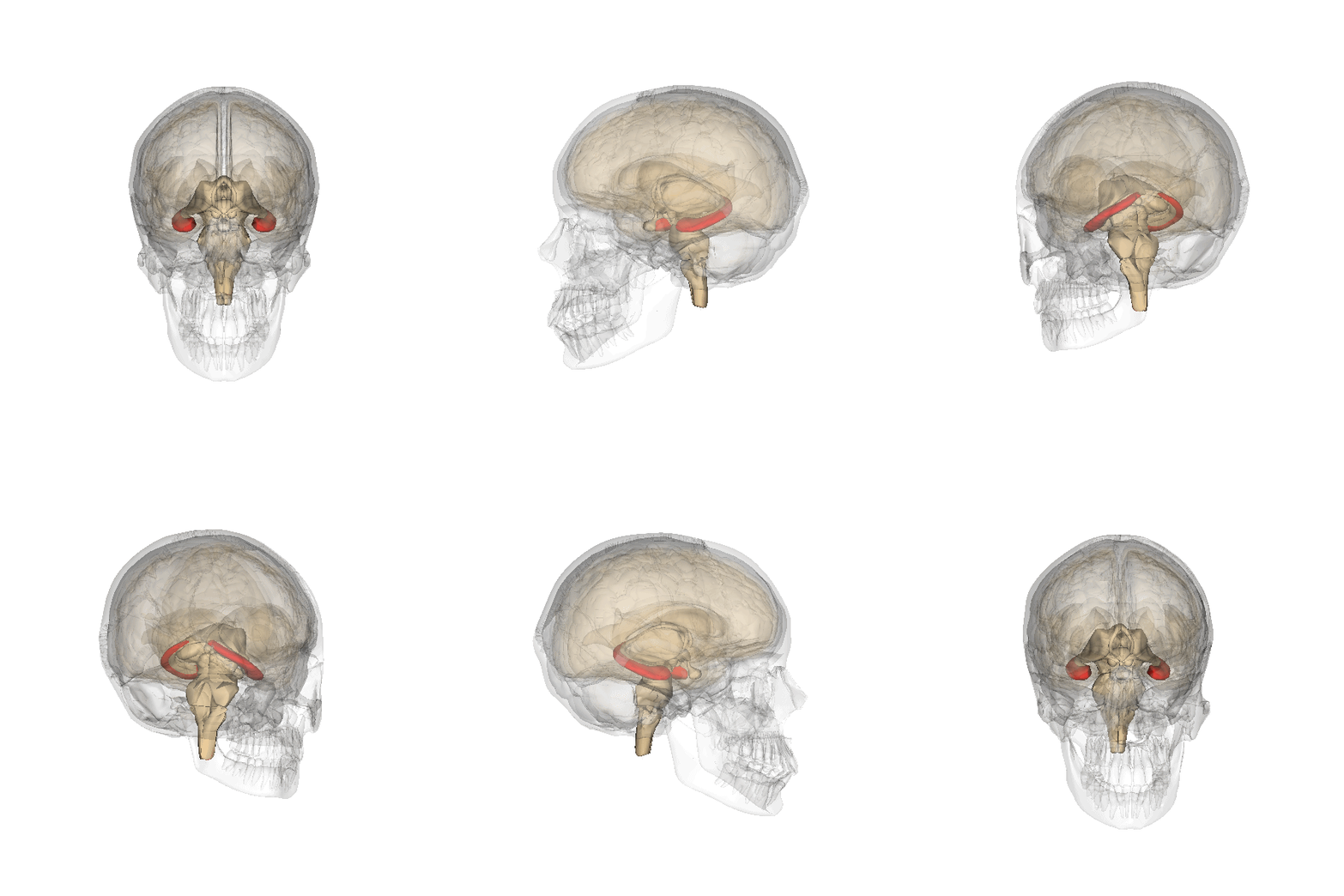
The hippocampus is located in the medial temporal lobe of the brain. In this lateral view of the human brain, the frontal lobe is at left, the occipital lobe at right, and the temporal and parietal lobes have largely been removed to reveal the hippocampus underneath.

MRI coronal view of a hippocampus shown in red.
MRI coronal view of a hippocampus shown in red

The hippocampus is a major component of the brains of humans and other vertebrates. It belongs to the limbic system and plays important roles in the consolidation of information from short-term memory to long-term memory and spatial navigation. Humans and other mammals have two hippocampi, one in each side of the brain. The hippocampus is a part of the cerebral cortex; and in primates it is located in the medial temporal lobe, underneath the cortical surface. It contains two main interlocking parts: Ammon's horn[1] and the dentate gyrus.

In Alzheimer's disease, the hippocampus is one of the first regions of the brain to suffer damage; memory loss and disorientation are included among the early symptoms. Damage to the hippocampus can also result from oxygen starvation (hypoxia), encephalitis, or medial temporal lobe epilepsy. People with extensive, bilateral hippocampal damage may experience anterograde amnesia—the inability to form or retain new memories.

In rodents, the hippocampus has been studied extensively as part of a brain system responsible for spatial memory and navigation. Many neurons in the rat and mouse hippocampus respond as place cells: that is, they fire bursts of action potentials when the animal passes through a specific part of its environment.

Hippocampal place cells interact extensively with head direction cells, whose activity acts as an inertial compass, and conjecturally with grid cells in the neighboring entorhinal cortex.
Since different neuronal cell types are neatly organized into layers in the hippocampus, it has frequently been used as a model system for studying neurophysiology.

The form of neural plasticity known as long-term potentiation (LTP) was first discovered to occur in the hippocampus and has often been studied in this structure. LTP is widely believed to be one of the main neural mechanisms by which memory is stored in the brain.

Friday, 9 August 2013

D-amino acid oxidase - Wikipedia

D-amino acid oxidase - Wikipedia, the free encyclopedia

D-amino acid oxidase (DAAO; also DAO, OXDA, DAMOX) is a peroxisomal enzyme containing FAD as cofactor that is expressed in a wide range of species from yeasts to human.[1] It is not present in plants or in bacteria which instead use D-amino acid dehydrogenase. Its function is to oxidize D-amino acids to the corresponding imino acids, producing ammonia and hydrogen peroxide.

This enzyme belongs to the FAD dependent oxidoreductase family, and acts on the CH-NH2 group of D-amino acid donors with oxygen as acceptor. The enzyme is most active toward neutral D-amino acids, and not active toward acidic D-amino acids.

Recently, mammalian D-amino acid oxidase has been connected to the brain D-serine metabolism and to the regulation of the glutamatergic neurotransmission. In a postmortem study, the activity of DAAO was found to be two-fold higher in schizophrenia.[2]

DAAO is a candidate susceptibility gene[3] and together with G72 may play a role in the glutamatergic mechanisms of schizophrenia.[4]

DAAO is used as a biocatalyst in several biotechnological applications, such as the oxidation of cephalosporin C, the deracemition of racemic D-amino acid solutions and as the biological component in several biosensors for the determination of the content in D-amino acids of biological fluids.
This protein may use the morpheein model of allosteric regulation. [5]

See also

External links

Kim final pmemory testimonial - School of Phenomenal Memory


Published on 16 Nov 2012
School of Phenomenal Memory - http://www.Pmemory.com